Eyle Official | The New Luxury Is Peace


How Emotional Background Noise Is Quietly Reshaping Modern Life
There was a time when luxury was defined almost entirely by visibility.
More success. More access. More productivity. More information. More noise.
But increasingly, people are beginning to desire something entirely different:
Relief.
Not disappearance from life. Not disengagement from ambition. Not avoidance of responsibility.
Relief from constant emotional input.
Modern life has become emotionally loud.
Notifications arrive before people fully wake up.
Work follows people home through phones and laptops. Social media delivers a nonstop stream of outrage, comparison, urgency, tragedy, commentary, performance, branding, advertising, and emotional access to thousands of strangers simultaneously.
Even moments meant for rest have become saturated with stimulation.
And while society often talks about burnout as a dramatic collapse, many people are experiencing something quieter.
A slower form of depletion.
A kind of emotional accumulation.
People are not only becoming exhausted from major stressors. Increasingly, they are becoming exhausted from constant low-level emotional exposure.
The pressure to respond. The pressure to consume. The pressure to stay updated. The pressure to remain emotionally available at all times.
What emerges from this environment is what EYLE™ describes as:

Emotional Background Noise™
The ongoing accumulation of emotional, informational, and psychological input that continuously occupies mental space — even during moments intended for rest.
Unlike traditional burnout, emotional background noise is subtle. It often hides beneath functional routines.
People continue going to work. They continue replying to messages. They continue posting online. They continue performing productivity.
Yet internally, many feel mentally saturated.
This may help explain why increasing numbers of people report:
difficulty concentrating
emotional numbness
reduced excitement
social fatigue
overstimulation
chronic mental exhaustion
shortened attention spans
emotional irritability
feeling “full” despite inactivity
Research increasingly reflects these broader shifts. According to the American Psychological Association Stress Research, chronic stress exposure continues to affect emotional regulation, sleep, physical health, and overall mental well-being. Workplace studies from Gallup Workplace Research continue to document rising disengagement and emotional exhaustion among employees globally.
At the same time, attention itself has become one of the most competed-for resources in modern society.
Technology platforms are designed around engagement. News cycles move faster than human emotional processing. Social algorithms reward urgency, reaction, and emotional intensity. Many people are consuming more emotional information in a single week than previous generations encountered in months.
The result is not simply distraction.
It is fragmentation.
EYLE™ refers to this growing phenomenon as:
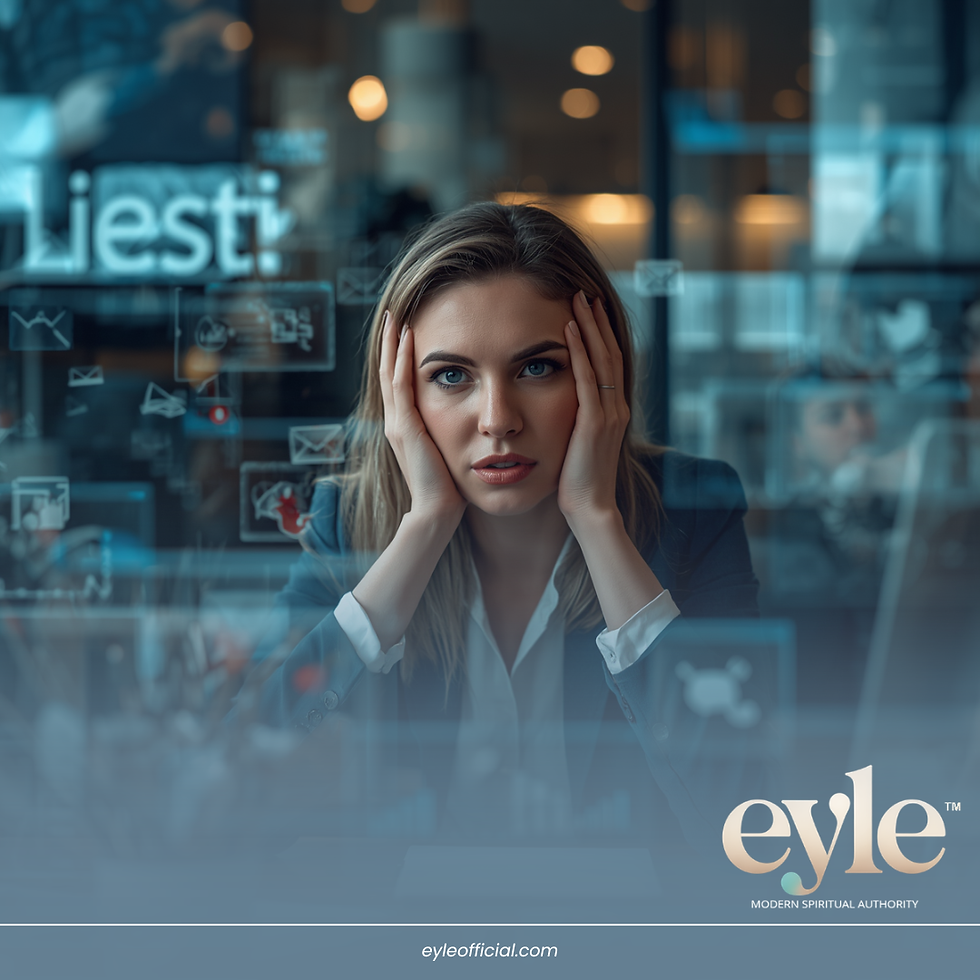
Attention Fragmentation™
A condition in which constant interruption weakens a person’s ability to sustain emotional clarity, deep focus, internal stillness, and psychological recovery.
This fragmentation affects more than productivity.
It affects relationships.
Decision-making.
Creativity.
Sleep quality.
Emotional regulation.
Self-awareness.
In many cases, people are no longer operating from genuine rest. They are operating from accumulated emotional carryover.
This may also explain the rise of another emerging cultural shift:

Peace Anxiety™
As overstimulation becomes normalized, some individuals begin feeling uncomfortable in calm environments. Silence feels unfamiliar. Slower pacing feels unproductive. Rest creates guilt instead of restoration.
Stress becomes mistaken for momentum.
Chaos begins to feel psychologically familiar.
The modern wellness conversation is evolving partly because of this contradiction. Increasing numbers of people are beginning to recognize that external success means very little when internal life feels continuously overloaded.
This has created a growing cultural pivot away from performative wellness and toward emotional preservation.
Minimalism.
Boundary culture.
Intentional living.
Reduced social access.
Digital detoxes.
Slower routines.
Private healing practices.
Calmer aesthetics.
These are not random trends.
They reflect a broader emotional correction.

According to research from Pew Research Center and workplace behavioral reporting from Harvard Business Review, younger generations increasingly prioritize flexibility, emotional well-being, and quality of life alongside traditional achievement markers.
In other words:
People are reevaluating what success should actually feel like.
The cultural aspiration is quietly shifting from visible performance to internal stability.
This does not mean ambition is disappearing.
If anything, many people are becoming more intentional about where their energy is invested. Emotional clarity itself is increasingly becoming a form of personal and professional advantage.
Calm people often think more clearly. Rested people make better decisions. Focused people waste less energy. Emotionally regulated people recover faster from pressure.
In this way, peace is no longer being viewed simply as self-care.
It is becoming infrastructure.
Not luxury in the traditional sense.
But luxury in the modern sense:
uninterrupted attention
emotional clarity
spaciousness
stability
the ability to think without constant intrusion
The future of wellness may not belong to the loudest voices.
It may belong to the people and environments capable of creating genuine psychological breathing room in a world increasingly defined by emotional saturation.
And perhaps that is why peace has started to feel so valuable.
Not because people suddenly became less ambitious.
But because modern life became so emotionally crowded that calm itself began to feel rare.
Key Cultural Concepts Introduced by EYLE™
Emotional Background Noise™
The accumulation of low-level emotional, informational, and psychological stimulation that continuously occupies mental space.
Attention Fragmentation™
The weakening of sustained focus, emotional clarity, and internal stillness caused by constant interruption and overstimulation.
Peace Anxiety™
The discomfort some individuals experience in calm environments after prolonged adaptation to stress and overstimulation.
Sources & Research
American Psychological Association — Stress Effects on the Body and Mind
Gallup Workplace Research
Deloitte Global Gen Z & Millennial Survey

Sheila Boyd
Founder of EYLE™ | Editorial Wellness & Intentional Living Commentary
Sheila Boyd is the founder and editorial voice behind EYLE™, a modern wellness and intentional living platform focused on emotional clarity, workplace wellness culture, attention fatigue, and contemporary lifestyle trends. Her work explores how modern environments, digital culture, and emotional overstimulation influence everyday well-being, focus, and human behavior.
Editorial portrait of Sheila Boyd, founder of EYLE™, a modern wellness and intentional living platform.
Instagram: @eyle.alignment
Website: www.eyleofficial.com
About EYLE™
EYLE™ is a modern wellness and intentional living brand focused on emotional clarity, cultural wellness trends, workplace emotional dynamics, and intentional self-development. Through editorial commentary, wellness insights, and reflective lifestyle content, EYLE™ explores how modern culture impacts emotional well-being, focus, and everyday life.
Editorial Note: Portions of the visuals and production workflow associated with this article may include AI-assisted creative tools. All written commentary, conceptual framing, and editorial direction reflect the original perspectives and brand voice of EYLE™. This article is provided for informational and cultural commentary purposes only and does not constitute medical or mental health advice.